

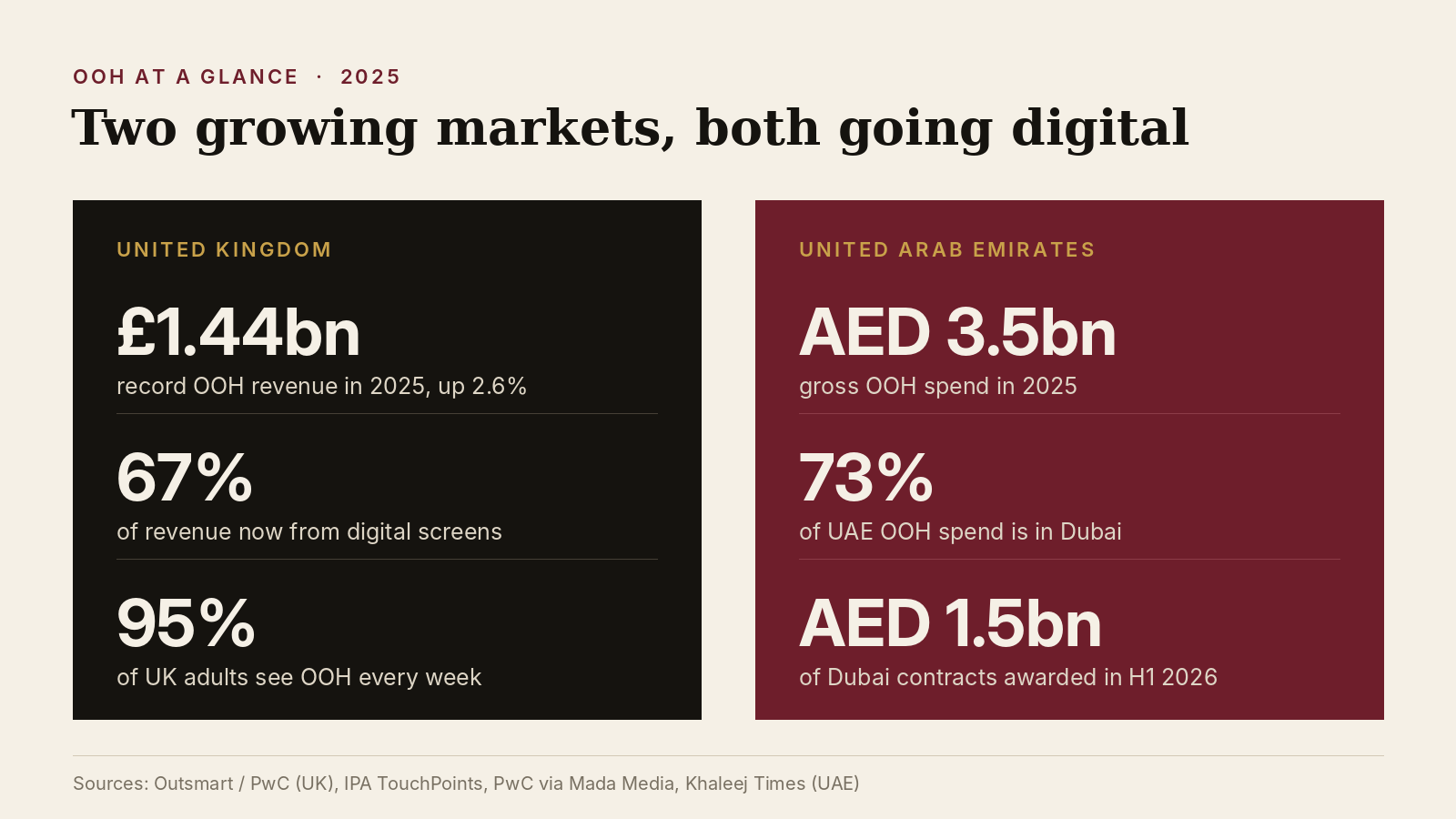
In 2025, UK out-of-home (OOH) revenue reached a record £1.44bn. In the UAE, gross OOH spending reached roughly AED 3.5bn. While feeds get noisier and ads get skipped, brands are putting more money into the one medium people cannot scroll past.
If you are weighing whether OOH belongs in your next campaign, here is what has changed, what the evidence says, and how brands in London and Dubai are winning with it.
OOH advertising in numbers: UK vs UAE
Both markets are growing, and in both the money is moving to digital screens.
| UK | UAE | |
|---|---|---|
| Market size, 2025 | £1.44bn, the highest ever (Outsmart) | About AED 3.5bn gross spend (Khaleej Times) |
| Digital share | 67% of revenue, rising to 69% in Q4 2025 | Nearly one-third of outdoor spend, and climbing (invidis) |
| Momentum | +2.6% in 2025, with H2 growth of 3.8% | AED 1.5bn of Dubai contracts awarded across 683 sites in H1 2026 |
| Where it concentrates | 95% of UK adults see OOH every week (IPA TouchPoints, via Alight Media) | Dubai accounts for about 73% of UAE OOH spend (PwC) |
The UAE story is one of rapid upgrade. Dubai’s regulator, Mada Media, says around 80 companies bid for sites in the first half of 2026. One operator, Hills Advertising, is investing USD 265m, including converting 20 bridge sites on key Dubai corridors to digital screens.
What has changed: from static billboards to smart media
It is digital and programmatic. Digital out-of-home (DOOH) screens can be bought by audience, time of day, weather or location, and changed in minutes. Heinz used real-time weather triggers to time its soup ads across UK roadside and bus-shelter screens.
It is measurable. Campaigns are now tracked through footfall attribution, brand-lift studies, mobile location data and sales analysis, the same evidence you expect from digital channels.
It drives online action. Outsmart’s OutPerform study found OOH lifted smartphone brand actions, such as searches and website visits, by 17%. Among the top 20 campaigns, the uplift reached 38%, and 57% of those who acted were new or lapsed customers (Outsmart).
It cannot be skipped. No ad blockers, no “skip ad” button and no scrolling. In a crowded attention economy, that matters more every year.
5 OOH success stories from Dubai and London
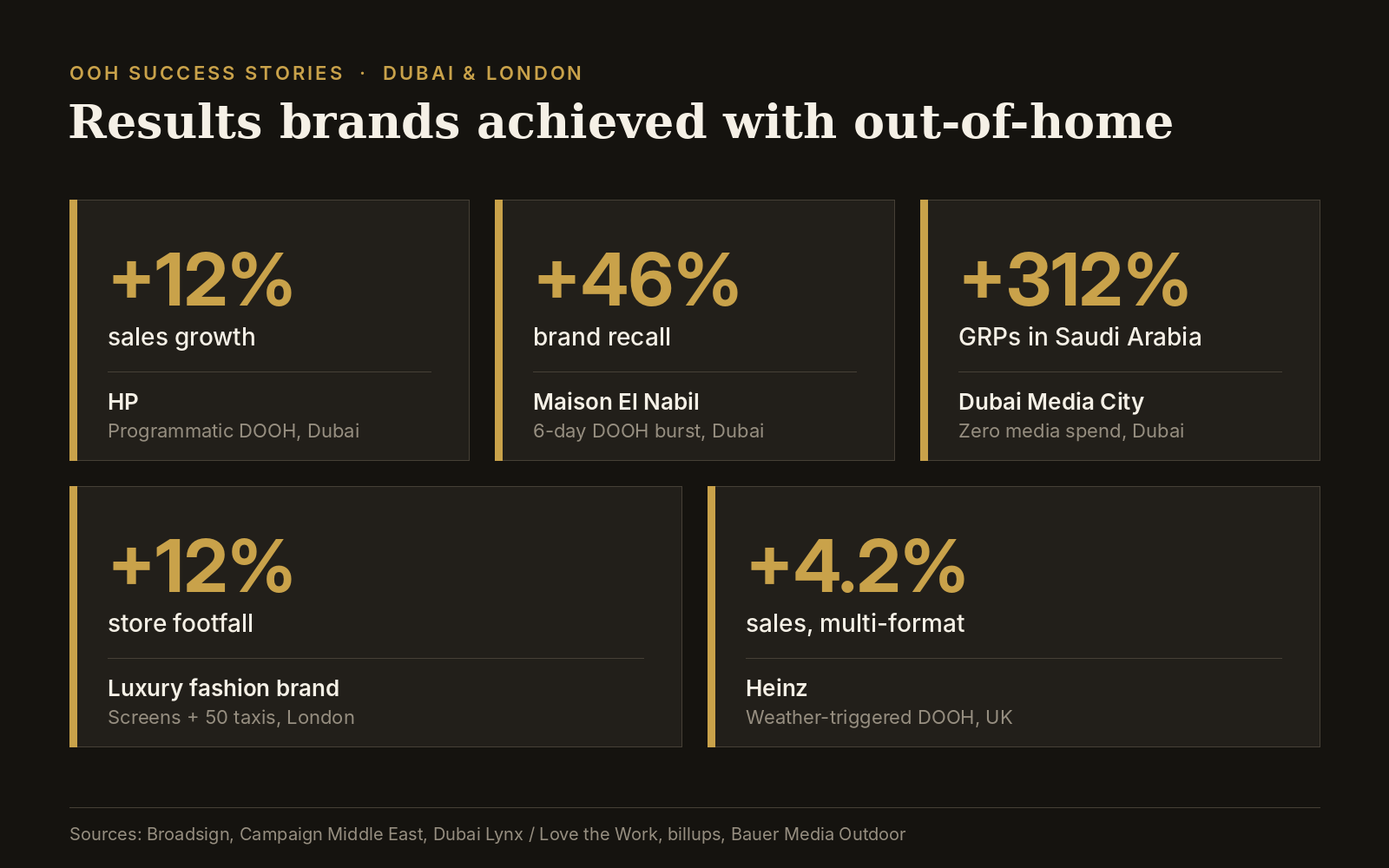
HP, Dubai: +12% sales. Facing low awareness for its Smart Tank printers, HP ran a programmatic DOOH campaign in Dubai aimed at parents aged 25–54. It contributed to 12% year-on-year sales growth in the UAE and doubled positive brand image among people who recalled the ads (Broadsign).
Maison El Nabil, Dubai: +46% recall in six days. The French fragrance house timed an AI-powered DOOH campaign with Beauty World Dubai. Brand recall rose 46%, purchase intent reached 41%, and the brand climbed to second place in spontaneous awareness among perfume brands (Campaign Middle East).
Dubai Media City: the region’s most-viewed billboard, for zero media spend. A branded construction barrier sat behind the presenters of a daily Al Arabiya TV show, earning free airtime every morning. It lifted GRPs by 312% in Saudi Arabia and 90% in the UAE, and won a Dubai Lynx Bronze (Love the Work).
Luxury fashion brand, London: +12% footfall. A four-week, £410k campaign combined landmark screens with 50 fully wrapped electric taxis. It delivered 18.9m impressions, 60% above target, and 13,700 extra store visitors (billups).
Heinz, UK: up to +4.2% sales. A weather-triggered campaign across roadside billboards, bus shelters and DOOH lifted sales by 2.5% overall, and by 4.2% where several formats ran together (Bauer Media Outdoor).
The pattern is clear: the strongest results come from precise timing, premium locations and several formats working together.
5 reasons OOH belongs in your 2027 marketing plan
It grows the whole business. A 2025 IPA study by effectiveness expert Peter Field found brands putting at least 15% of budget into OOH saw 17% higher sales value, 25% higher profit and a 100% uplift in market-share effects versus brands without it (The Media Leader).
It makes your digital spend work harder. The same research found OOH power users boosted search effectiveness by 129% and social effectiveness by 17%. People see your brand on the street, then search for it on their phone.
It reaches people beyond your existing customers. More than half of those who acted on OOH were new or lapsed customers, which is exactly where growth comes from.
It builds status and trust. Earlier IPA analysis found OOH power users lifted brand esteem by 41% and fame by 32% (WARC). For jewellery, luxury and lifestyle brands, being seen in the right place signals scale and credibility.
It is flexible. You can run a six-day burst around an event, switch creative by daypart, or own a high street near your stores. Short, targeted campaigns are now as viable as long national ones.
Choosing the right OOH format in the UK and UAE
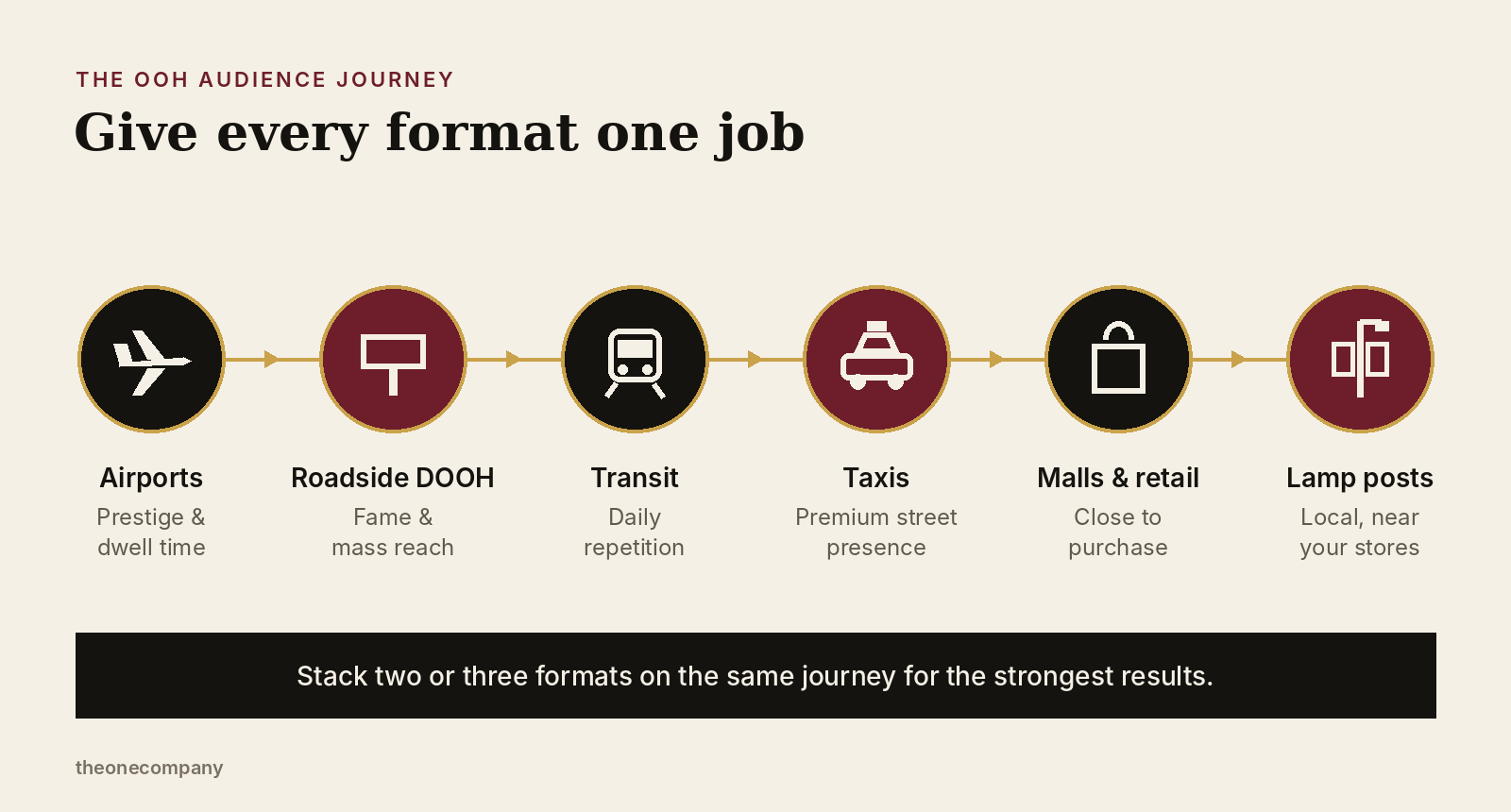
Every format does a different job, so start with what you need it to achieve, not the biggest screen available.
| Format | Best for | UK examples | UAE examples |
|---|---|---|---|
| Airports | Premium, international and high-spending audiences with long dwell time | Heathrow, Gatwick, Manchester, Birmingham | Dubai International (DXB), Abu Dhabi, Sharjah |
| Roadside and DOOH | Mass reach, launches, brand fame | M4 corridor, Cromwell Road, Birmingham and Leicester ring roads | Sheikh Zayed Road, Al Khail Road, Dubai bridge screens |
| Transit | Daily repetition along commuter routes | London Underground, buses, rail stations | Dubai Metro, buses and stations |
| Malls and retail | Reaching shoppers close to the point of purchase | Westfield London and Stratford, Bullring | Dubai Mall, Mall of the Emirates, Dubai Hills Mall |
| Taxis | Street-level reach through premium districts | London black cabs, wrapped electric taxis | Dubai and Abu Dhabi taxi tops and wraps |
| Lamp posts and street furniture | Hyper-local presence near your stores | High streets such as Southall and Wembley | Community and retail districts across the emirates |
The strongest campaigns combine two or three formats along the same audience journey, as Heinz’s multi-format results showed.
How to plan an OOH campaign that performs
Map your audience’s journey. Know where your customers live, commute, shop and spend their weekends, then place your brand along that route.
Give each format one job. Use roadside for fame, transit for repetition, malls for purchase and lamp posts for local presence.
Design for the setting. A driver has seconds, while a traveller at an airport gate has minutes. Use one bold image, a few words and your logo, and never simply resize a social ad.
Adapt for each market. A message that works in London may need different imagery, language or cultural cues in Dubai. Check local permit rules early, as Dubai now runs approvals through a central regulator.
Set your success measure before booking. Choose footfall, brand lift, search uplift or sales, and agree the baseline before the campaign goes live.
Frequently asked questions
What is out-of-home advertising?
Out-of-home (OOH) advertising is any advertising people see outside their homes: billboards, digital screens, bus shelters, lamp posts, taxis, transport hubs, malls and cinemas.
What is programmatic DOOH?
Programmatic digital out-of-home is the automated buying of digital billboard space using data triggers such as audience, time of day, weather or location, so ads appear when they are most relevant.
Is OOH advertising still effective?
Yes. UK revenue hit a record in 2025, and IPA data links meaningful OOH investment to higher sales, profit and market share, plus stronger search and social performance.
How is an OOH campaign measured?
Through footfall attribution, brand-lift surveys, mobile location data, search uplift and sales analysis against a baseline.